
polyminds Innovations
December 18, 2025
For decades, Western Maharashtra has been the nerve center of Maharashtra’s political, cooperative, and industrial landscape. This region has historically remained a bastion of the Congress and the Nationalist Congress Party (NCP), under the undisputed influence of Sharad Pawar and his loyal political ecosystem.
However, since 2014, the Bharatiya Janata Party (BJP) has systematically tried to penetrate this stronghold. While the party made inroads into urban centers like Pune during the Modi wave, rural voters linked to the cooperative sector remained largely unmoved. Despite the national tide favoring the BJP, the NCP managed to hold ground in constituencies like Madha, Satara, Baramati, and Kolhapur.
The 2019 Assembly elections were a turning point. Sharad Pawar’s emotive campaign – characterized by his defiance against the Enforcement Directorate and his rain-soaked rallies – reinvigorated the party’s base and delivered unexpected success.
But after the NCP’s split in 2023, the political equations shifted rapidly. Many of the stalwarts who once stood shoulder to shoulder with Sharad Pawar crossed over with Ajit Pawar to join hands with the BJP. The 2024 Lok Sabha elections saw the INDIA bloc gain momentum in Maharashtra, riding on strong narratives around Constitutional protection, social justice, the Maratha reservation issue, and anti-incumbency against sitting MPs, coupled with timely candidate selection.
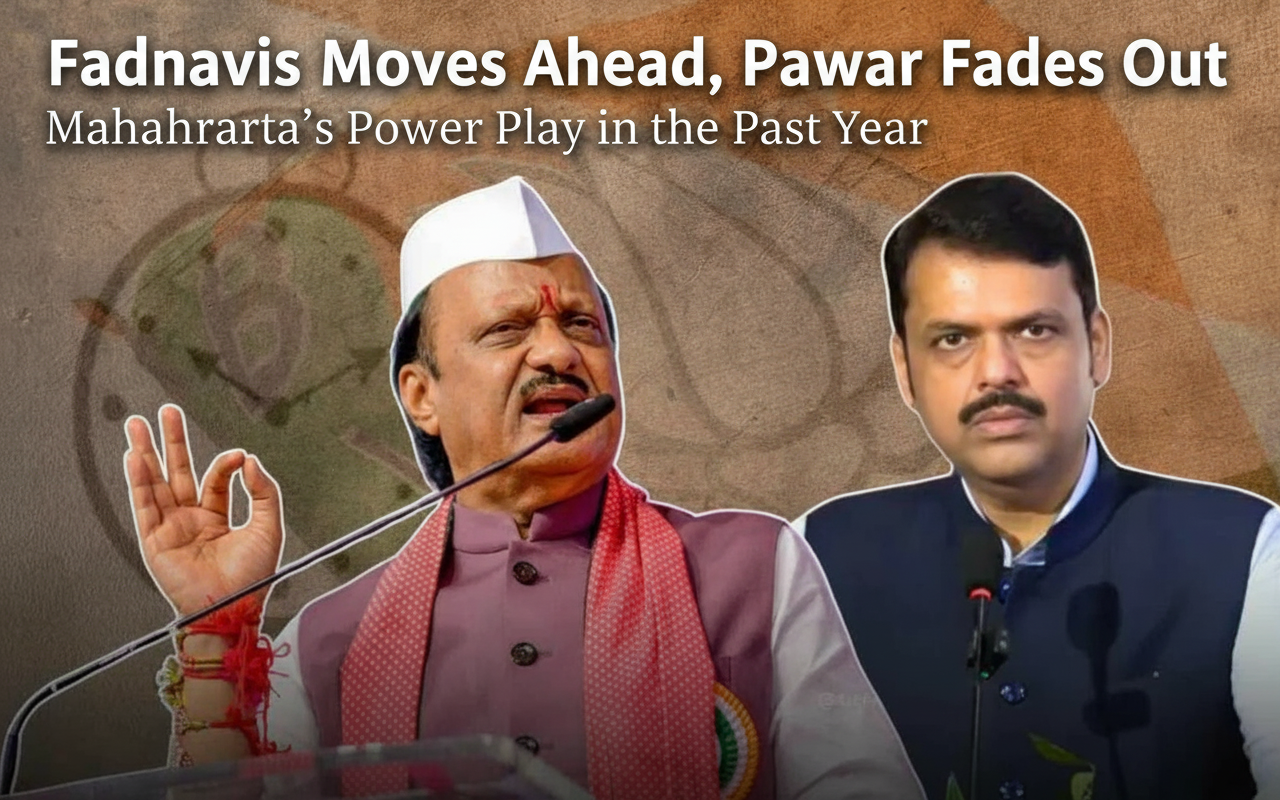
While the BJP-led alliance managed to retain power in 2024 AE, the internal fault lines were exposed – especially for Ajit Pawar’s faction. Despite holding office, his political footing continues to weaken.
Ajit Pawar inherited a legacy-heavy party but without the moral or emotional capital that Sharad Pawar commanded. Western Maharashtra, particularly Solapur and nearby rural belts – traditionally loyal to the elder Pawar – have shown signs of disillusionment under Ajit’s leadership. His attempts to control these constituencies have only fueled factionalism, driving several grassroots leaders out of his fold.
Even after entering the ruling alliance, Ajit Pawar’s NCP faction remains directionless. BJP has assigned them a tactical role to split Congress’s traditional Muslim vote base. Ironically, while Ajit Pawar holds minority outreach programs across Maharashtra, his own legislators have made statements that openly alienate the Muslim community. This contradiction exposes a deep identity crisis within his camp – one that neither aligns fully with BJP’s ideology nor retains its earlier secular cooperative appeal.
Sharad Pawar, in his prime, commanded figures like Vijaysinh Mohite-Patil, Padamsinh Patil, and Madhukarrao Pichad – each aware of their limits under a dominant leader. Ajit Pawar lacks that stature. His ambition is restricted to becoming Chief Minister, whereas Sharad Pawar’s horizon stretched to Delhi. This difference in vision and scale explains the stark contrast between their leadership arcs.
Meanwhile, Devendra Fadnavis continues to demonstrate why he remains one of the most astute strategists in Indian politics today. His political maneuvering, especially in balancing multiple allies – from Eknath Shinde’s Shiv Sena faction to Ajit Pawar’s NCP has been nothing short of a calculated masterstroke.
Fadnavis seems to be playing a long game: consolidating power not just for the BJP but reshaping Maharashtra’s political DNA itself. His understanding of timing, optics, and ground coordination has allowed BJP to maintain dominance despite visible anti-incumbency and internal friction among allies.
Eknath Shinde’s Shiv Sena faces its own existential challenge. Leading a party once synonymous with Balasaheb Thackeray’s fierce Marathi pride, Shinde has struggled to maintain ideological coherence. For now, his relevance to the BJP lies in retaining Marathi votes in Mumbai and Thane during upcoming local body elections as well as capitalising a soft corner for him in the Maratha community. But in the long run, the shared “Hindutva” voter base will naturally gravitate toward the BJP’s stronger organizational pull.
Maharashtra’s politics is moving toward a bipolar structure either pro-BJP or anti-BJP. The blurred lines of political loyalty and coalition opportunism are giving way to clearer voter choices. The once-chaotic “mixture politics” of Maharashtra is evolving into a more defined ideological landscape.
The ongoing process of social and political realignment is redefining voter behavior, alliances, and even leadership hierarchies. In this new phase, adaptability, ideological clarity, and credibility will determine survival – not just electoral arithmetic.
In essence, Maharashtra is witnessing a silent but significant transformation – a political evolution where Devendra Fadnavis’s methodical strategy stands tall, while Ajit Pawar’s reactive politics seems to be fading into irrelevance.

